

The buying behaviour of B2B customers is currently changing in a way that challenges traditional marketing approaches. In this article, we discuss three key changes in B2B buying and recommend concrete steps your business can take to thrive in the new environment.
This article is based on a presentation by Quru's Otso Karvinen on changing B2B buying behaviour at the MarkkinointiKollektiivi International Marketing Afternoon in August 2025.
Table of Contents
- Three key changes in B2B buying
- How B2B marketing should respond to this change
- ABM strategy as a precise remedy for B2B buying behaviour change
- Frequently asked questions from us on this topic
Three key changes in B2B buying
Longer and more complex buying paths
Every year, Dreamdata publishes B2B benchmark data, where they use data from their platform to examine the average buying paths of B2B companies.
The report, published in 2024, finds that the average B2B buying path currently has more than 60 touchpoints, the buying process typically takes more than 200 days and involves more than 10 people in the decision-making process.
This is a significant challenge for marketing.
The question is: how can a company stay relevant to its various stakeholders and target groups throughout the lengthening purchase path and ultimately close the deal?
This challenge requires long-term engagement and the adaptation of messages and actions to the different stages of the purchase path.
Gartner's visualisation of 'The New B2B Buying Journey' illustrates well how complex B2B buying is:
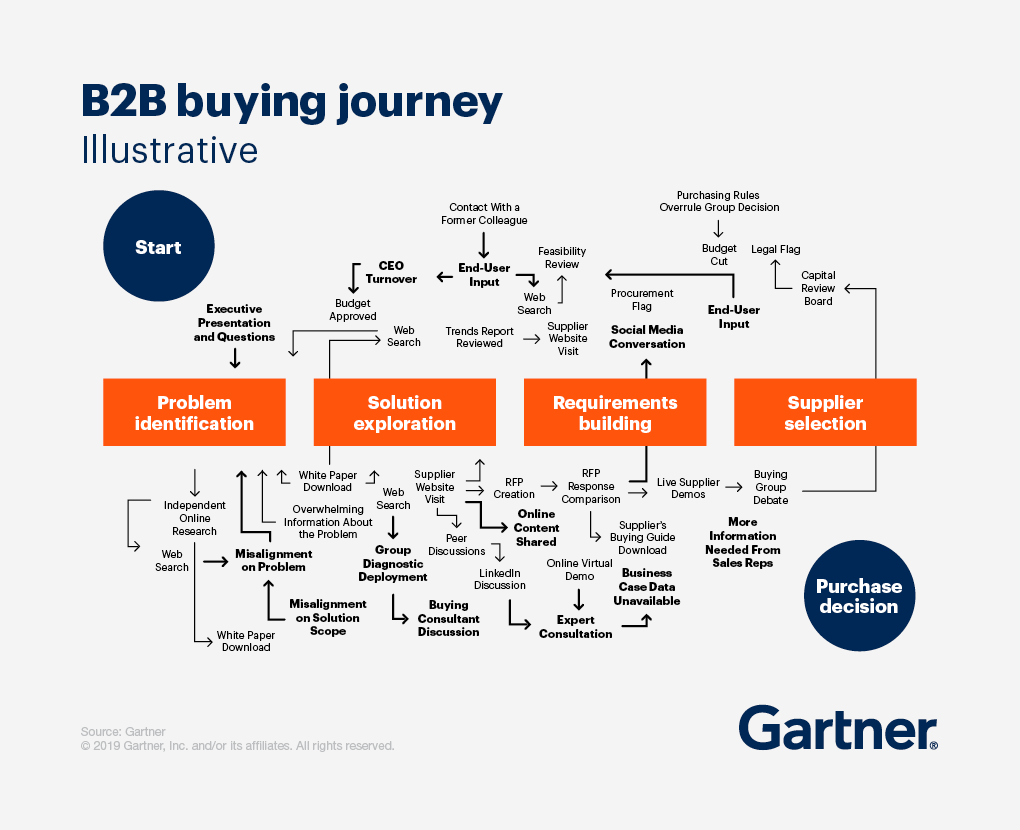
The buying journey is not chronological or a traditional 'buying funnel', but rather a crossover between different stages of the buying process. A customer may go through a needs assessment phase, move on to the supplier selection phase and then realise that we had a completely different need, going back to the needs definition phase.
Shifting purchasing to digital channels
Another big change is that buying is rapidly moving to digital channels. Customers want more self-service options, they want to do their research themselves and to go further in the purchasing process independently.
In its 2025 Sales Predictions report, Forrester predicts that more than half of large B2B purchases will be made through digital channels this year. Sales will still be involved in the acquisition process, but often at a much later stage.
This means that the responsibility for convincing the target company is increasingly shifting to the marketing desk. This is another reason why it is important to build strong brand awareness and trust through marketing at an early stage, before the buyer even has contact with the company's vendors.
The role of artificial intelligence in purchasing decisions
Forrester's B2B Journey Survey found that 89% of B2B buyers say they have incorporated AI into their research and decision-making.
So AI is already playing a significant role in the early stages of the buying journey. Buyers use it to search for information and find alternatives, and for marketing, AI offers opportunities for signal recognition, content creation and personalisation.
How should B2B marketing respond to this change?
Measure the actual customer journey (as deeply as you can)
Our first recommendation is to understand and measure the real customer journey as much as possible. As stated earlier, the purchase path is not linear, but a network of different touch points and sales and marketing events.
However, this does not mean that the purchase path and the impact of the different actions cannot or should not be monitored and measured.
Here are our recommendations in three points:
- Make full use of existing measurement. Consider whether you are making full use of your company's analytics, CRM data and sales data. Is there anything else available that could be further refined and better exploited? It is likely that there is still valuable data to be gathered from your current systems.
- Upgrade your tracking to include hidden data. For example, company-specific IP identification or self-reported attribution (i.e. when a form asks "where did you hear about us") is an extremely good way to measure what influenced the contact.
- Build a better view of the impact of marketing on sales. Dashboards that incorporate attribution and attribution modelling depending on the business, what data can be used and what the business is like. Dreamdata, for example, offers advanced revenue attribution solutions. There are also advanced capabilities within Salesforce and HubSpot that are worth exploring.
To aggregate data, it is recommended to use so-called "data warehouse" or "data lake" tools such as Google's BigQuery or Snowflake. The data can then be reported and visualised using tools such as Microsoft's PowerBI or Google's Looker / Looker Studio.
These tools provide more insight into the actual customer journey and the actions that can be taken to influence it.
Prioritise and target effectively
Another recommendation is to prioritise and target effectively. You simply cannot do everything with limited resources.
Forrester's 2024 Sales Buying Journey study found that successful B2B companies are able to prioritise and invest much more deeply in narrowly selected target accounts.
For many B2B companies, ABM, or account-based marketing, is the appropriate strategy. ABM thinking helps to focus efforts in a way that avoids the "one size fits all" approach to marketing. More on the ABM strategy at the end of the article.
Here are Quru's three-point recommendations for prioritisation and targeting:
- Ensure that your company has clearly defined ICPs (Ideal Customer Profile) and that an understanding of them is shared throughout the organization. Everyone needs to agree on what the ideal customer is.
- Segment your target companies. For example, a certain number of ideal customers are likely to be the best, i.e. Tier 1 customers. Resources and interventions should be targeted primarily at these companies.
- Run an ABM pilot campaign. An ABM strategy is often a big change and a reasonably heavy process for a B2B company. An excellent way to start testing the effectiveness of the strategy is to build an ABM pilot campaign, for example for the top 10 companies. A pilot campaign is often a good way of proving the impact of the strategy and getting buy-in from within the company.
Ensure seamless collaboration with sales
The third recommendation is to ensure seamless collaboration with sales. Marketing and sales should be able to play towards the same goals with a similar playbook.
Here are our recommendations, from the easiest to the most challenging:
- Start joint weekly meetings. This may sound obvious, but if sales and marketing are actually brought around the same table, to look at joint reports, the joint game is bound to improve.
- Go through a winning deal together. Make a "deal diagnosis", i.e. put that won deal on the table and see what all the marketing and sales measures have been along the way. These are often surprising reviews.
- Agree on one common KPI to measure the success of both. It could be the sales pipeline in euros or the number of new sales opportunities. Most importantly, there should be one common goal for sales and marketing success.
- Introduce account-based reporting. All sales and marketing activities are reported at account level, i.e. at the level of the target company, not at channel level or as a separate sales and marketing activity.
- Establish a Revenue Operations team. This is the most cumbersome measure, but effective. RevOps combines sales, marketing and customer service functions under one team. This is demanding on the organization, but if successful, can be a driver of growth.
ABM strategy as a panacea for B2B buying behaviour change
Account Based Marketing is an excellent response to the change in buying behaviour. A Gartner study of companies that have adopted an ABM strategy showed strong results. Virtually every company had found the impact of the ABM strategy to be positive.
The biggest impacts were:
- Shorter sales cycle - process becomes more efficient by focusing on the right targets
- Higher win rate on deals - deeper understanding of the customer improves success rates
- Greatercustomer lifetime value - a more strategic approach deepens the customer relationship
The ABM approach responds directly to the challenges posed by changing buying behaviour.
As buyers move independently further along the purchase path, ABM enables relevant and personalised communications at every stage. When several people are involved in the purchasing decision, ABM takes into account the needs of the whole decision-making unit.
-----
If you made it this far, thank you for your time! We hope our article sparked some thoughts on how you can start developing your marketing to support changing b2b buying behaviour.
If you would like to discuss this topic further, please contact us
Frequently asked questions on this topic
What is the biggest change in B2B customers' buying behaviour in recent years?
The biggest single change is the lengthening and complexity of the buying path. According to Dreamdata research, the average B2B purchase path now has more than 60 touch points, takes more than 200 days to complete and involves more than 10 decision makers.
How has B2B digital marketing changed in line with buying behaviour?
B2B digital marketing has become increasingly self-service based to respond to the changing buying behaviour of B2B customers. Forrester predicts that more than half of large B2B purchases will be made using digital channels in 2025, with customers wanting to explore options and move further along the buying process independently than in the past. This will increasingly shift the responsibility for convincing the target company to the marketing desk.
How will AI affect B2B purchasing decisions?
According to a Forrester study, 89% of B2B buyers use AI as part of their research and decision-making process. AI helps with information retrieval, comparing alternatives and supporting decision-making. For marketers, this means the need to optimise content for AI and use AI in the marketing efforts themselves.
What is ABM marketing and why is it responding to changing buying behaviour?
ABM (Account-Based Marketing) is a strategy whereby B2B marketing activities are targeted to a carefully selected group of potential customers on an individual basis. It responds directly to the change in buying behaviour of B2B customers: as buyers move independently further along the purchase path, ABM enables relevant and personalised communication at every stage. When several people are involved in the buying decision, ABM takes into account the challenges and needs of the entire buying committee.
How do I start using an ABM strategy?
We recommend starting with an ABM pilot campaign for your top 10 target companies. First, make sure your company has clearly defined ICPs (Ideal Customer Profiles) and segment the target companies by importance. A pilot campaign is a good way to prove the impact of the strategy and to gain internal commitment to the new approach before rolling out the strategy more widely across the organisation.